TOP PICKS
SaleBestseller No. 1 −6%
Texas Instruments BA II Plus Financial Calculator, Black Medium
- Profitability calculations; cash flow function Calculates NPV and IRR for uneven cash flows
- Time-value-of-money and Amortization keys solve problems including: pension calculations, loans, mortgages, etc.
- Ideal calculator for students, managers and statisticians
- Built-in functionality : List-based one- and two-variable statistics with four regression options: linear, logarithmic, exponential and power
- The BA II Plus calculator is approved for use on the following professional exams: Chartered Financial Analyst exam. GARP Financial Risk Manager (FRM) exam. Certified Management Accountants exam
Bestseller No. 2
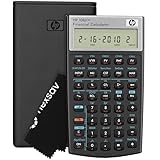
HP 10bII+ Financial Calculator, 100+ Functions, Statistics & Algebra
- HP 10BII+ FOR STUDENTS & PROFESSIONALS – This HP calculator is built for business, finance, accounting, and statistics courses. Perfect for learners and professionals who need to solve common financial problems quickly without memorizing formulas or relying on spreadsheets.
- 100+ FUNCTIONS FOR REAL WORLD MATH – Quickly solve time value of money, interest rates, loan payments, NPV, IRR, cash flows, and more. The 10bII+ also includes probability distributions for statistics courses—a feature not often found in financial calculators.
- ALGORITHMIC INPUT WITH DEDICATED KEYS – This high-school/college calculator uses algebraic and chain logic with minimal keystrokes. Layout appears the same as standard calculators for easy learning. Dedicated keys give quick access to commonly used financial and statistical functions
- APPROVED FOR MAJOR EXAMS – The HP 10bII+ algebra calculator is permitted for use on SAT, PSAT/NMSQT, and AP tests. An ideal statistics calculator and business calculator for school finance and accounting students preparing for class, coursework, or standardized exams.
- INCLUDES TRAVEL CASE, CLEANING CLOTH & BATTERIES– Slim, durable, and easy to keep on hand or store in a backpack or locker. Includes a protective case, cleaning cloth, and batteries so it’s ready out of the box. Large screen with clear contrast (non-backlit) is easy to read during exams or lectures.
Bestseller No. 3
BA II Plus Professional Financial Calculator Texas Instruments
- Solves time-value-of-money calculations such as annuities, mortgages, leases, savings, and more
- Performs cash-flow analysis for up to 32 uneven cash flows with up to 4-digit frequencies
- Calculates various financial functions: Net Future Value Net present Value Modified Internal Rate of Return Internal Rate of Return Modified Duration Payback Discounted Payback
- The Texas Instruments BAII Plus Professional features an Automatic Power Down (APD) function for extended battery life
- Prompted display guides you through financial calculations showing current variable and label. Ten-digit display
Bestseller No. 4
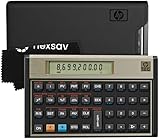
HP 12C Financial Calculator – 120+ Functions: TVM, NPV, IRR, Amortization, Bond Calculations, Programmable Keys – RPN Desktop Calculator for Finance, Accounting & Real Estate – Includes Case...
- HP 12C: INDUSTRY STANDARD SINCE 1981 – Trusted by professionals in real estate, banking, and finance for over 40 years. The HP 12C finance calculator remains the go-to tool for fast and accurate calculations in high-stakes business environments.
- 120+ FUNCTIONS FOR FINANCIAL ANALYSIS – Calculate loan amortization, bond pricing, mortgage payments, NPV, IRR, depreciation, and more with this large calculator. Built-in business and statistical functions allow you to perform complex calculations in just a few keystrokes.
- RPN ENTRY FOR FASTER WORKFLOWS – Reverse Polish Notation (RPN) allows for efficient data entry with fewer keystrokes and no formulas. This RPN calculator is perfect for a mortgage payment calculator, accounting calculator, business calculator, or real estate calculator for desktop.
- PROGRAMMABLE FOR REPEAT TASKS – The HP12C desk calculator stores custom keystroke sequences for repeated use. This large calculator supports up to 20 cash flows for IRR/NPV analysis, modeling investment scenarios, projecting returns, and automating routine calculations.
- INCLUDES CLEANING CLOTH, CASE & BATTERIES – Compact design fits easily on a desk or crowded table area. Includes a protective carrying case, cleaning cloth, and comes with pre-installed batteries so it's ready to use out of the box. A great choice for home finances, business professionals, and accountants.
Bestseller No. 5
HP 10bII+ Financial Calculator
- Brand New in box; The product ships with all relevant accessories
- Dedicated keys allow easy access to common financial and statistics functions
- Easy-to-use design provides business, finance and statistical calculations fast
- Specially designed to meet the mathematical needs
Bestseller No. 6
HP 2716570 10bII+ Financial Calculator, 12-Digit LCD
- Sold as 1 Each.
- Ideal for students and professionals. Over 100 built-in functions including probability distributions.
- Intuitive keyboard layout with minimal keystrokes required for many common functions.
- Easy-to-read display with adjustable contrast and on-screen labels.
- Permitted for use on SAT, PSAT/NMSQT and College Board AP tests.
Bestseller No. 8
HP 2716570 10bII+ Financial Calculator, 12-Digit LCD
- Sold as 1 Each.
- Ideal for students and professionals. Over 100 built-in functions including probability distributions.
- Intuitive keyboard layout with minimal keystrokes required for many common functions.
- Easy-to-read display with adjustable contrast and on-screen labels.
- Permitted for use on SAT, PSAT/NMSQT and College Board AP tests.
Bestseller No. 10

HP 12C Platinum Financial Calculator, 130+ Functions, RPN, Undo Key
- HP 12C PLATINUM: FOR FINANCE PROFESSIONALS – Designed for advanced users in banking, investing, and corporate finance. The HP 12C Platinum finance calculator is ideal for pros who require precision, flexibility, and the ability to handle more complex financial modeling.
- 130+ FUNCTIONS FOR ADVANCED ANALYSIS – Calculate loan payments, interest rates, bond prices, amortization, depreciation, IRR, NPV, and more with this large calculator. The 12CP's expanded functionality supports more in-depth business analysis and financial decision-making.
- RPN OR ALGEBRAIC ENTRY + UNDO KEY – Choose between Reverse Polish Notation or standard algebraic logic. Includes both Undo and Backspace keys. This RPN calculator is perfect for a mortgage payment calculator, accounting calculator, business calculator, or real estate calculator for desktop.
- 30 CASH FLOWS + EXAM APPROVED – Store up to 30 cash flows for internal rate of return and net present value calculations. This desk calculator is approved for use on CFP, CFA, and GARP FRM exams. Part of HP’s trusted lineup of exam-ready financial calculators used by professionals for decades.
- INCLUDES CLEANING CLOTH, CASE & BATTERIES – Slim and easy to store on any desk or workspace. Comes with a protective case, cleaning cloth, and pre-installed batteries so you can start using it right away. Suitable for office use, meetings, exam prep, or daily financial work.
BUYING GUIDE
Financial calculators are essential tools for finance students, professionals, and anyone who needs to make complex calculations related to financial planning, banking, investing, or real estate. Unlike regular calculators, they are specifically designed to perform financial functions like calculating interest rates, cash flows, or amortization schedules. Here’s a guide to help you choose the best financial calculator for your needs:
1. Purpose: Consider why you need a financial calculator. For instance, if you’re a student, find out if your course or exam board recommends a specific model. Some financial calculators are more suited to professionals in particular fields, such as banking, real estate, or investment.
2. Functions: A good financial calculator should be capable of performing a wide range of financial functions, such as calculating net present value (NPV), internal rate of return (IRR), amortizations, and compound interest. Make sure the calculator you choose can handle the specific calculations you need.
3. Ease of Use: Some financial calculators are more user-friendly than others. Look for a calculator with a clear, readable display, intuitive layout, and easy-to-navigate menu. A good manual or guidebook can also be a great help.
4. Programmability: Some financial calculators allow you to program formulas or equations into the device, which can be a useful feature if you regularly perform complex or specialized calculations.
5. Durability and Quality: Consider the build quality and durability of the calculator. It should be sturdy enough to withstand daily use, and the buttons should feel comfortable and responsive.
6. Price: The price of financial calculators can vary significantly. While more expensive models often offer additional features, a lower-priced model may be sufficient for your needs, especially if you’re a student or beginner.
7. Battery Life: Look for a calculator with a long battery life, so you won’t have to worry about it dying in the middle of an important calculation or exam.
8. Brand Reputation: Some brands are well-known for their reliable and high-quality financial calculators. Hewlett-Packard (HP) and Texas Instruments are two such examples.
By considering these factors, you can choose the best financial calculator that suits your needs and helps you tackle complex financial tasks with ease.