"Amazon, Amazon Prime, the Amazon logo and Amazon Prime logo are trademarks of Amazon.com, Inc. or its affiliates". Advertising Disclosure
BestChoice.guide ratings are based on a multitude of verified customer feedback and our attention is solely on products that we truly value. If you choose to click on the links to the products we mention, we could receive an affiliate commission, but this will not cause you any additional costs.
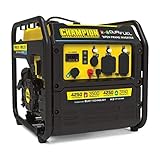
Operate your 4000-watt portable generator right out of the box on either gasoline or propane, plus features CO Shield carbon monoxide auto shutoff system
With an ultra-quiet 64 dBA from 23 feet, enjoy 4000 starting watts, 3000 running watts and up to 10 hours run time on gasoline, and 2700 running watts and up to 25 hours on propane
The optional, sold-separately parallel kit enables this inverter to connect with another Parallel Ready Champion Inverter or Power Station for more power and longer run time
Includes a 120V 25A TT-30R outlet, a 120V 20 A household duplex outlet (5-20R) with clean electricity (less than 3% THD), plus a 12V automotive-style outlet, and Parallel outlets
Includes 3-year limited warranty with FREE lifetime technical support from dedicated experts
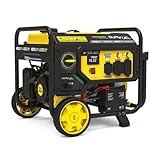
ADVANCED DIGITAL HYBRID DESIGN: 50% quieter and 20% lighter than a traditional Champion 3500-watt generator, plus our Economy Mode feature saves fuel and extends engine life
DUAL FUEL: This RV Ready inverter operates on gasoline or propane and has a 120V 30A RV, plus two 120V 20A household outlets and 12V DC outlet with dual USB adapter
QUIET TECHNOLOGY: 64 dBA is great for RVs, tailgating, your next project or home backup, with 4250 starting watts and 3500 running watts for up to 22 hours run time on gasoline
PARALLEL READY: If you purchase the optional ParaLINK Parallel Kit, you can increase your power output by connecting up to two 3000-watt or higher inverter generators
CHAMPION SUPPORT: Includes 3-year limited warranty with FREE lifetime technical support from dedicated experts
Dual Fuel: Operate your 4500-watt portable generator right out of the box on either gasoline or propane, plus features CO Shield carbon monoxide auto shutoff system
Quiet Technology and Extended Run Time: 61 dBA is great for RVs, tailgating, or camping with 4500 starting watts, 3500 running watts and up to 14 hours run time on gasoline, and 3150 running watts and up to 21 hours on propane
Parallel Ready: The optional parallel kit (sold separately) enables this inverter to connect with another Champion inverter to increase your power output
Intelligauge with Power Meter: Monitor voltage, frequency and operating hours with ease, plus the EZ Start Dial simplifies startup
Champion Support: Includes 3-year limited warranty with FREE lifetime technical support from dedicated experts
Operate on either gasoline or propane. Run up to 14 hr. on gas or 10.5 hr. on propane, with 68 dB(A) operation ideal for camping, RVs, or backup power.
Trust the reliable 224cc Champion engine with battery-included, push-button electric start.
Produces 4750 starting watts and 3800 running watts on gasoline, and 4275 starting watts and 3420 running watts on propane.
Intelligauge with tracks voltage, frequency, and run time, plus includes CO Shield carbon monoxide auto-shutoff system.
Comes with a 3-year limited warranty, FREE lifetime technical support from dedicated experts, and access to a network of service centers across the country.
4650 Peak Watts & 3600 Rated Watts (Gasoline); 4650 Peak Watts & 3240 Rated Watts (Propane); 4 Gallon Fuel Tank (with Fuel Gauge); Up To 14 Hours of Run Time Per Tank
Features One 5-20R 120V Household Duplex Receptacle, One RV-Ready TT-30R 30 Amp Receptacle, and One L5-30R 30 Amp Receptacle; All Outlets Have Rubber Covers for Added Safety
Plug-and-Play: Comes with Oil, an Oil Funnel, a Tool Kit, and a User's Manual to Get You Started Right Out of the Box (Minimal Assembly Required)
Powered by a 212cc Westinghouse 4-Stroke OHV Engine Featuring a Long-Lasting Cast Iron Sleeve with Automatic Low Oil and Carbon Monoxide (CO) Shutdown
All Westinghouse Portable Generators are Functionally Tested in the Factory and May Contain Minimum Residual Oil and/or Fuel Odor; EPA Compliant; Backed By 3-Year Limited Service, Labor, and Parts Coverage and Nationwide Customer Service Network
Operate your 9200-watt portable generator right out of the box on either gasoline or propane, plus features CO Shield carbon monoxide auto shutoff system
Power up the 459cc Champion engine with the handy rocker switch, battery included
Keep track of voltage, hertz and run-time hours to easily monitor output and track maintenance intervals
At 11,500 starting watts and 9200 running watts on gasoline and 10,350 starting watts and 8280 running watts on propane, trust Volt Guard to protect your generator from electrical voltage spikes.
Includes 3-year limited warranty with FREE lifetime technical support from dedicated experts
Dual-Fuel Operation (Gasoline & Propane): Features a 141cc OHV air-cooled engine operating on gasoline (4500 peak watts / 3500 rated watts) or propane (4150 peak watts / 3200 rated watts). Includes propane (LPG) hose with regulator.
Clean Inverter Power (<3% THD): Our gas generator delivers less than 3% THD for sensitive electronics. Equipped with one 120V 20A (NEMA 5-20R) duplex receptacle, one 120V 30A (TT-30R) outlet, dual USB ports, and one 12V 8A DC output. All outlets are circuit breaker protected.
Quiet and conversation-friendly: With 58 dBA noise level at 23 feet. Fully enclosed design reduces noise to meet national park requirements. ECO mode adjusts engine speed to save fuel and lower sound emissions.
Parallel Capability & CO Safety: Connect two units with a parallel kit (not included) to double power output. Integrated carbon monoxide (CO) sensor automatically shuts down the engine during unsafe conditions.
Compact and lightweight: The portable inverter generator with built-in handle for easy transport to jobsites, RVs, campsites, pole barns, and homes.
Dual Fuel: Operate your 6875/5500-watt portable generator right out of the box on either gasoline or propane, plus the unit holds 1.2-quarts of oil (included) and has a low oil shut-off switch.
Volt Guard: Prevents overloads and keeps your valuable equipment safe from voltage spikes, plus a voltmeter allows you to monitor power output at a glance
Intelligauge: Keep track of voltage, frequency and run-time hours to easily monitor output and track maintenance intervals, plus features CO Shield carbon monoxide auto shutoff system.
Powerful: At 6875 starting watts and 5500 running watts on gasoline and 6250 starting watts and 5000 running watts on propane, trust Volt Guard to protect your appliances from electrical voltage spikes
Champion Support: Includes 3-year limited warranty with FREE lifetime technical support from dedicated experts
Operate your 11,000-watt portable generator right out of the box on either gasoline or propane, plus features CO Shield carbon monoxide auto shutoff system
At 11,000 starting watts and 9,000 running watts on gasoline, and 11,000 starting watts and 8,100 running watts on propane, enjoy up to 15 hours of run time on a full tank of gasoline with a noise level of 64 dBA from 23 feet
Trust the reliable 459cc Champion engine with its battery-included electric start feature and built-in Cold Start Technology for easy starts in cold weather
Two 120V 20A GFCI household duplex outlets, a 120/240V 30A locking outlet, a 120/240V 37.5A outlet, and a 12V automotive-style outlet
Includes 3-year limited warranty with FREE lifetime technical support from dedicated experts
Propane generators are a popular choice for backup power solutions due to their clean-burning properties, long shelf life of fuel, and reliability. Ideal for both residential and commercial use, propane generators provide an efficient and eco-friendly alternative to gasoline or diesel generators. Whether you need emergency power for your home, a reliable source for outdoor events, or a backup for critical business operations, choosing the right propane generator involves assessing various factors including power output, portability, and additional features. This guide will help you understand the key aspects to consider when selecting the best propane generator for your needs.
Key Features to Consider
Power Output and Efficiency
Wattage Requirements: Determine the wattage you need by adding up the power requirements of all devices and appliances you plan to run simultaneously. Make sure the generator can handle the peak load, especially during startup.
Fuel Efficiency: Propane is known for its efficiency and cost-effectiveness. Evaluate the generator’s fuel consumption to ensure it meets your expectations for operational cost and runtime.
Fuel Storage and Safety
Propane Storage: Unlike gasoline, propane can be stored indefinitely without degradation, which makes it an excellent choice for infrequent but crucial use. Consider the size of the propane tank you will need based on your power usage and expected runtime.
Safety Features: Propane is a highly flammable gas, so safety features such as automatic shut-off, carbon monoxide detectors, and leak detectors are critical.
Portability and Installation
Size and Mobility: If you need a generator that can be easily moved around, look for models with wheels and handles. However, larger units may require a permanent installation spot.
Installation Complexity: Larger propane generators often require professional installation, especially if they are integrated into home or business power systems.
Noise Level
Quiet Operation: Propane generators tend to operate more quietly than their gasoline counterparts. However, noise levels can still be a concern, especially in residential areas. Check the decibel ratings to ensure they meet local noise ordinances.
Durability and Maintenance
Build Quality: Choose a generator that is built to withstand the elements, especially if it will be used outdoors or in harsh conditions.
Maintenance Requirements: While propane generators generally require less maintenance than gasoline generators, regular checks and upkeep are still necessary to ensure peak performance.
Additional Features
Automatic Start: Some models offer an automatic start feature, which is particularly useful for home backup power, activating the generator when the power goes out.
Power Management: Look for generators with advanced power management capabilities that allow you to prioritize which appliances to power during an outage.
Pros and Cons
Pros of Propane Generators
Cons of Propane Generators
✔️ Cleaner burning, producing fewer emissions than gasoline or diesel
❌ Higher initial cost for purchase and installation than some gasoline models
✔️ Fuel can be stored indefinitely without degradation
❌ Less energy-dense than gasoline, potentially requiring larger fuel tanks for equivalent runtime
✔️ Typically quieter operation, suitable for residential use
❌ Requires proper handling and storage to ensure safety due to flammability
✔️ Low maintenance due to cleaner combustion
❌ Fewer models to choose from compared to gasoline generators
Quick Tips
Assess Your Power Needs: Understand the total wattage required for your essential devices to ensure you choose a generator with adequate output.
Consider Usage Frequency: If the generator is for emergency use, propane’s long shelf life could be a significant advantage.
Plan for Safety and Compliance: Ensure proper installation and adherence to local regulations regarding fuel storage and generator use.
Choosing the right propane generator means balancing power needs with fuel efficiency, operational noise, and safety considerations. By carefully evaluating these factors, you can select a propane generator that provides reliable and efficient power, meets environmental standards, and fits your specific energy requirements. Whether for home backup, business continuity, or recreational use, a propane generator is an excellent investment for ensuring power availability when you need it most.